
If you’ve searched anything on Google recently, you’ve likely seen it: a block of AI-generated text at the very top of the results that answers the question before you’ve clicked a single link.
That’s a Google AI Overview. And for B2B business owners, it represents a more significant shift than most people have caught up with yet — because it changes not just how search works, but how your buyers discover, research, and shortlist suppliers.
How Google Search Has Changed in the AI Era
Search engines used to work like an index. You typed a query, Google returned a list of links, and you clicked through to find an answer.
That model is being replaced.
Google now increasingly tries to answer the question itself, synthesising information from across the web into a single AI-generated response — displayed before any organic results, any ads, and any competitor listings.
The practical consequence for businesses: your buyers may be getting an answer that references your competitors without ever seeing your website.
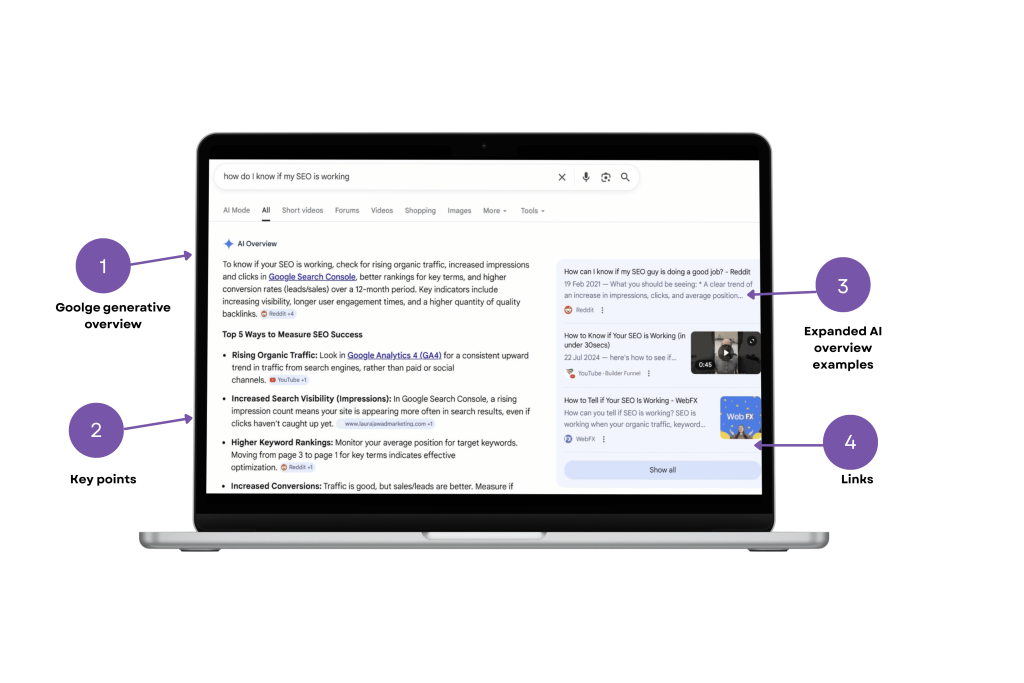
What Is a Google AI Overview?
A Google AI Overview is an AI-generated summary that appears at the very top of search results — in position zero, above all organic and paid listings.
It works by scanning Google’s index for relevant, reliable sources, processing that content with a large language model, and generating a direct answer to the query. Source links are included, but many users won’t click them. The answer is already there.
Google rolled out AI Overviews to all users in 2024. They now appear regularly across informational and research-led queries — exactly the kind of searches your buyers make when they’re evaluating whether they need a service like yours.

What Google AI Overviews Mean for B2B Businesses
This is where it gets specific.
B2B buying journeys are research-heavy. Before a decision-maker reaches out to a supplier, they’ve typically spent time reading, comparing, and building a mental shortlist. A significant portion of that research now happens through AI-assisted search.
When a buyer searches “how do I know if my SEO is working” or “what should a B2B content strategy include”, Google isn’t just returning links any more — it’s writing an answer. If your content informs that answer, your brand gets associated with the solution before a conversation even begins. If it doesn’t, a competitor does.
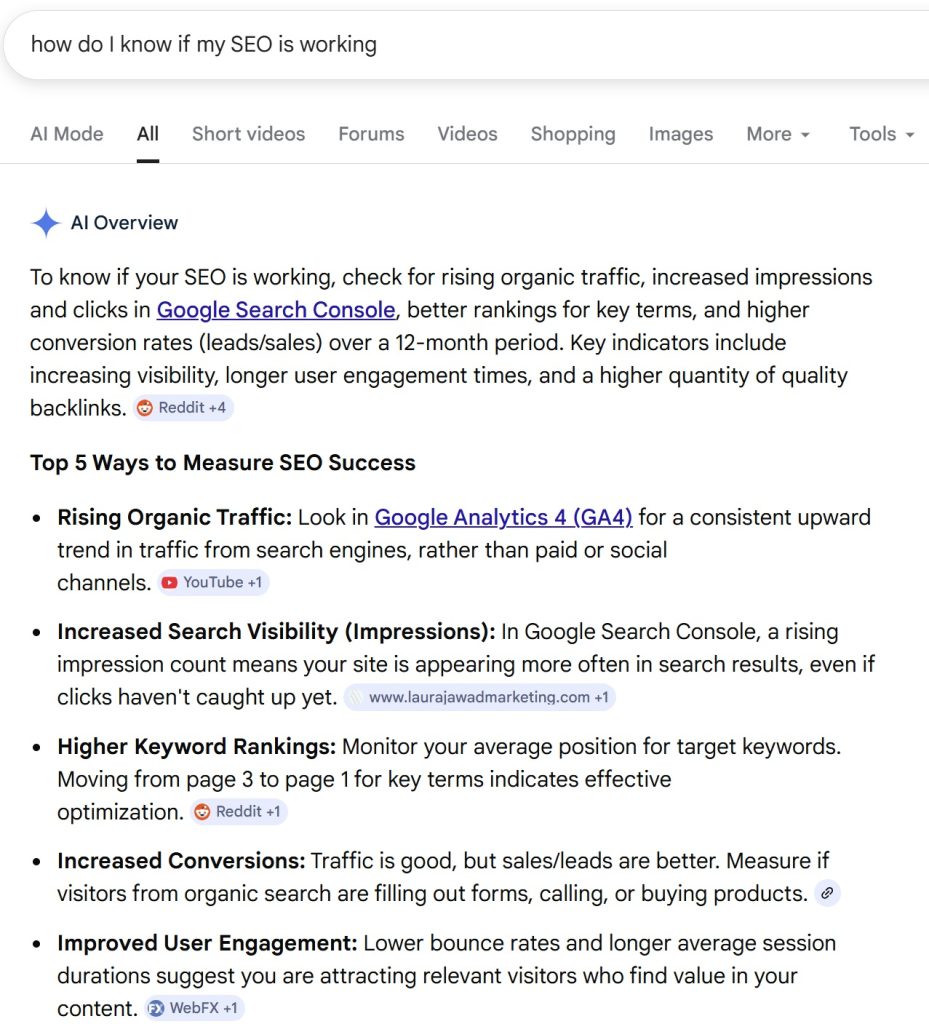
The shift isn’t just about traffic. It’s about where trust is built in the buying journey.
A few things worth understanding clearly:
Rankings and citations are different outcomes. A page can rank on page one and still not appear in an AI Overview. Google’s algorithm and its AI summarisation model don’t weight signals identically. In our own AI Search Audits, we regularly find businesses with solid organic rankings that are completely absent from AI-generated answers for the questions their buyers ask early in the journey.
One client we work with — a compliance consultancy ranking well for several mid-funnel terms — was getting consistent organic traffic but noticed their inbound enquiry rate had quietly flattened over six months. When we ran an AI visibility check, they were absent from every AI-generated answer for the research questions their buyers ask before shortlisting a supplier. Their rankings looked fine. Their AI presence was zero. The traffic was arriving, but the trust-building moment had already happened elsewhere — with a competitor who was being cited.
Zero-click behaviour is real, but it’s not the whole picture. Traffic to informational pages may fall even when you’re cited. But being seen in an AI Overview — even without a click — builds brand familiarity. A buyer may encounter your name in an AI answer, not click, and then return through branded search a week later when they’re ready to act. That attribution is invisible in most standard analytics setups, which is why the impact of AI visibility is currently being underestimated.
High-intent service queries behave differently. AI Overviews are more likely to affect informational and research-led queries than bottom-funnel searches like “B2B SEO agency London.” For those terms, traditional rankings still matter. The implication is that you need visibility at both levels — not just where buyers decide, but where they research.
What a Real B2B Buying Journey Looks Like Now
Here’s a scenario we see playing out regularly.
A head of operations at a mid-sized professional services firm needs to sort out their company’s approach to data compliance. They’re not ready to call anyone yet — they’re in research mode. They open Google and type something like “what should a data compliance policy include for a B2B company.”
Google returns an AI Overview. It pulls from three sources, writes a clear summary, and lists those sources underneath. The head of operations reads it, doesn’t click any of the links, and closes the tab.
Three days later they search again — this time something more specific. Another AI Overview appears. One of the same brands keeps coming up.
By the time they’re ready to actually speak to someone, that brand already feels familiar. Not because of an ad. Not because of a ranking. Because they kept showing up in the answers to the right questions at the right moment.
That’s the new buying journey for B2B. The decision doesn’t start with a click. It starts with a citation.
How to Improve Your Visibility in Google AI Overviews
The fundamentals haven’t disappeared — they’ve been extended. Quality content, technical health, and authority still matter. But getting cited in AI Overviews requires a few additional signals.
Structure your content around direct answers. AI models summarise content. If your pages are built around clear headings, opening sentences that answer the question immediately, and a logical flow, they’re far easier to cite. Use H2s that mirror real buyer questions. Don’t bury the answer in paragraph three.
Build topical depth, not just individual pages. AI Overviews favour sources that cover a subject consistently and in depth. A cluster of well-linked, related content signals to Google that you genuinely know this space. One strong article isn’t enough — a coherent body of work on a theme is. This is a core part of what we address in Generative Engine Optimisation work.
Strengthen your off-site brand presence. AI engines validate sources through what others say about you. Third-party mentions — in industry publications, business directories, review platforms, partner sites — all contribute to how trustworthy and authoritative your brand appears to an AI model. This is why citation-building and digital PR aren’t just traditional SEO tactics any more.
Think beyond clicks as a success metric. If you’re only measuring rankings and organic traffic, you’re missing part of the picture. Businesses winning in AI search are tracking assisted visibility, branded search volume over time, and lead quality — not just session counts. When the buying journey involves an AI Overview, the click may happen later, on a different device, or through a different channel entirely.
Use schema markup and structured data. FAQ schema, organisation schema, and how-to markup all help AI models understand what your content is about, who produced it, and what questions it answers. It’s not a guarantee of citation, but it removes ambiguity for the model parsing your page.
The Honest Pros and Cons
Where AI Overviews work in your favour:
- You can appear above well-established competitors if your content is better structured and more directly useful
- Being cited builds brand familiarity in the research phase, even without an immediate click
- It rewards substance — businesses with genuine expertise and clear positioning will consistently outperform those relying on keyword volume alone
Where it creates challenges:
- Traffic to informational content may fall even when you’re cited
- You have less control over how your content is presented or summarised
- Businesses with thin, outdated, or poorly structured content will find it difficult to compete
The net effect depends on where you’re starting from. Businesses with strong topical coverage, expert-led content, and clear entity signals are well positioned. Those without will need to build that foundation before AI visibility becomes a realistic outcome.
The Thing Most B2B Businesses Don’t Know Yet
Most business owners have no idea whether they’re being surfaced in AI search or not.
Standard rank tracking tools don’t show AI Overview citations. Google Search Console doesn’t segment them clearly. So while you may be reviewing your rankings each month and feeling broadly satisfied, you could be entirely invisible in the AI-generated answers your buyers are reading during the research phase — and have no idea.
That gap is exactly what an AI Search Audit is designed to close. We test how your business appears across Google AI Overviews, ChatGPT, Perplexity, and Gemini for the queries that matter to your buyers — then give you a clear, prioritised report on where you stand and what needs to change.
