
A lot of SEO still starts with keywords, and rightly so. They tell us what people are searching for, how they describe a problem and what kind of page they expect to find.
But now the keywords are only a small part of what search engines are trying to understand.
They also need to work out what the content is about. Not just the topic, but the actual people, businesses, places, products and organisations being mentioned, and how all of those things connect.
Those identifiable things are entities.
For a business, entity SEO is partly about making sure Google can join the dots without having to work unnecessarily hard. It means creating a clear enough picture of the company, its services, the people behind it and the wider sources associated with it.
It sounds fairly straightforward until you start looking at how a brand is actually represented across the web.
Usually, it is much messier than the website suggests.
What is entity SEO?
Entity SEO is the process of making the identity and context around a business, person or other identifiable thing clearer to search engines.
Say someone is searching for a technical SEO consultant.
From a traditional SEO perspective, we might look at whether a page targets the right query, matches the search intent, has useful content, receives relevant links and is technically sound.
The entity side adds another layer. Search engines may also need to connect that consultant with a particular business, their areas of expertise, relevant profiles and other sources that confirm those relationships.
Keywords haven’t suddenly become irrelevant because entities exist. They still help us understand demand and relevance. Entity SEO gives search engines more context around what those words actually refer to.
I understood the problem much better after doing an actual entity audit
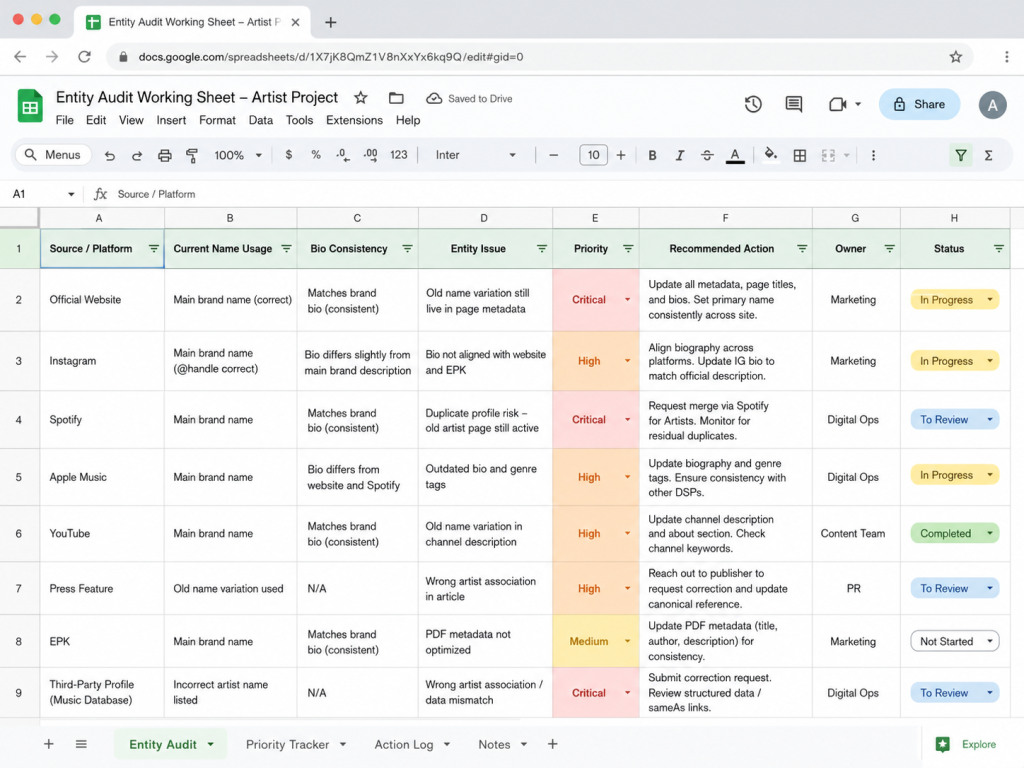
I recently worked on an entity audit for an established artist.
There was no shortage of information about them online. I would say quite the opposite. They had years of history, streaming profiles, social accounts, media mentions, biographies and older references.
Looking at any one of those profiles on its own, you probably wouldn’t have thought there was much of a problem.
Then I put them next to each other.
The preferred artist name was styled one way on the official material and social accounts, but differently on major streaming platforms. An older artist identity was still active in several places. Some biographies hadn’t caught up with the current positioning, while old third-party references were still appearing in search.
Then came the bigger one.
On one major streaming platform, the artist’s catalogue had been connected with the biography of an entirely different performer.
At that point, this stops being a theoretical conversation about structured data.
The web was effectively presenting several slightly different versions of the same person and, in one case, joining them to somebody else altogether.
Obviously, that’s a mess.
It is also a useful example of why entity SEO isn’t simply a case of adding Person schema and considering the job finished. Before correcting anything, I first needed to understand what information was already out there and where the conflicting signals were coming from.
Most entity problems don’t start on the website
We naturally look at the website first because that’s where most SEO work happens.
A brand’s digital identity, though, doesn’t live only on its own domain.
Information can be spread across LinkedIn, Google Business Profile, industry directories, professional databases, press coverage, social accounts, review sites, event pages, podcasts, partner websites and profiles somebody created seven years ago and then completely forgot about.
A company can update its positioning today and still have a 2019 biography ranking prominently for the founder’s name.
A rebrand can be perfectly implemented on the website while half a dozen external sources continue using the previous name.
A person might use their full professional name in one place, a shortened version elsewhere and a previous trading, professional or stage name on older profiles.
None of this automatically creates an SEO disaster. Businesses change and people change direction.
What matters is whether search engines can still understand how the old information relates to the current brand.
What should actually be consistent?
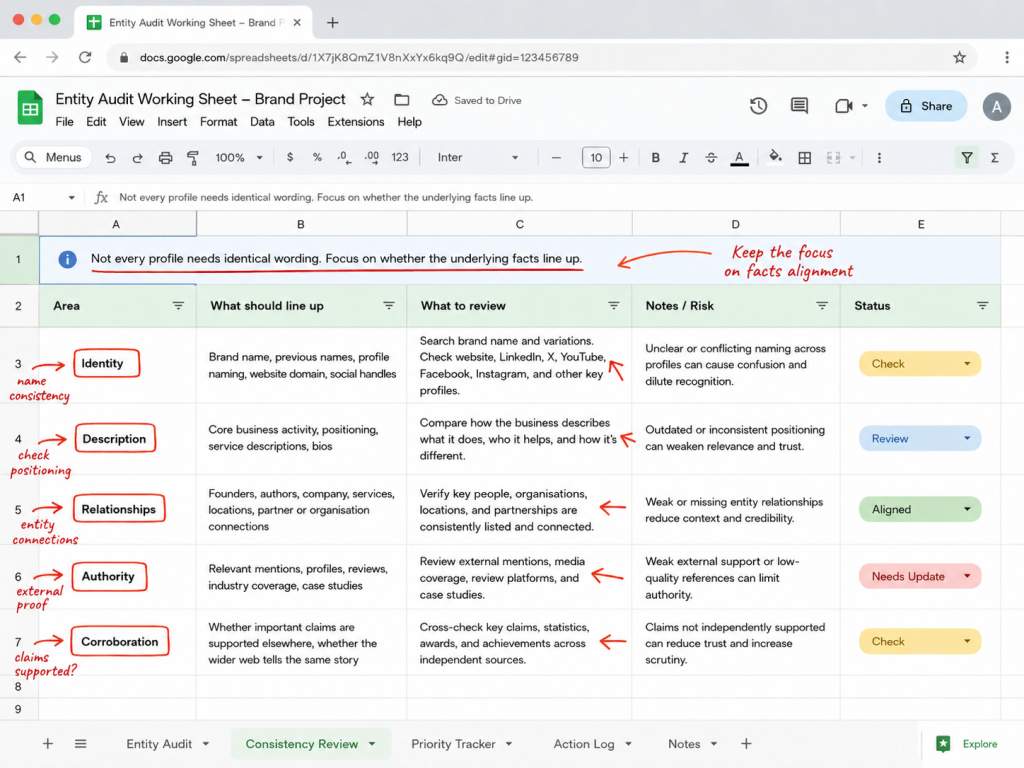
Not every profile needs to contain exactly the same description.
In fact, copying the same company paragraph onto every website you can find isn’t entity optimisation. It’s mostly just boring.
I’m more interested in whether the underlying facts line up.
The company name should make sense. The main activity shouldn’t change completely depending on the website you’re looking at. Important people should be connected with the right organisation. Current services shouldn’t be contradicted everywhere else by descriptions that stopped being accurate four years ago.
Previous names or identities don’t necessarily need to disappear either. Sometimes keeping that history visible is useful. The relationship simply needs to be understandable.
When I’m reviewing a brand, I tend to break this down into five areas.
1. Identity
First, can I confidently identify the business or person?
I look at the main brand or personal name, important variations, previous names, the official website, social profiles and basic business information.
Small variations aren’t automatically an issue. A person’s full name and shortened professional name can coexist perfectly well.
It becomes more interesting when there are multiple names with no clear relationship between them.
2. Description
Next I look at how the business or person is described.
A company doesn’t need to have the exact same biography everywhere. It would be strange if it did.
But if the website describes a specialist consultancy, LinkedIn presents a full-service agency and several industry profiles describe a completely different business model, that’s something I want to investigate.
Sometimes there is a perfectly good explanation.
Sometimes nobody has updated LinkedIn since 2021.
Both are worth knowing.
3. Relationships
This part gets more interesting because entities rarely exist in isolation.
A founder belongs to a business. A business provides services. An author writes about particular subjects. A company operates from or serves particular locations. A specialist may be connected with professional bodies, publications or other organisations.
Those relationships provide context.
If someone is presented as the founder of a company on the website but none of their significant external profiles connects them with that business, the relationship isn’t being reinforced particularly well.
The same thing happens when a company wants to become known for a specialist service that exists on one landing page but barely appears anywhere else in its online presence.
4. Authority
This is where entity SEO can easily turn into a game of collecting profiles.
I don’t find that particularly useful.
One hundred mediocre directory listings don’t suddenly make a business an authority.
I’d rather see fewer, stronger signals: relevant industry coverage, real partnerships, expert contributions, customer reviews, professional profiles, interviews, case studies, awards and mentions from sources that genuinely make sense.
Repetition isn’t authority.
And creating another twenty profiles purely so twenty more websites contain your company name isn’t much of a brand strategy either.
5. Corroboration
Finally, I look at whether important information about the business is supported elsewhere.
The company website will naturally make positive claims about the company. It belongs to them.
External sources give us another perspective.
If someone is positioned as an expert in a specialist field, does anything outside their own website support that? If a company talks about decades of experience, does its wider online record make sense alongside that history?
I don’t expect every sentence on an About page to have a matching independent citation somewhere on the internet. That would be ridiculous.
I’m looking for something broader: does the story hold together?
A simple audit might look like this:
| Source | Identity | Description | Key relationships | Current? | Action |
|---|---|---|---|---|---|
| Website | Consistent | Current | Partial | Yes | Strengthen |
| Consistent | Slightly different | Clear | Yes | Review | |
| Industry profile | Old variation | Outdated | Limited | No | Update |
| Third-party article | Consistent | Relevant | Clear | Yes | No action |
Once those sources are sitting next to each other, problems that were difficult to spot individually tend to become quite obvious.
That was exactly what happened in the artist audit.
The pattern was the problem.
Schema helps, but it isn’t the strategy
Schema appears almost immediately in most conversations about entity SEO.
And yes, it is useful.
Structured data can help search engines interpret information about an organisation, person, article, service or other identifiable thing. It can also make important relationships clearer in a machine-readable format.
But I wouldn’t start an entity audit by opening a schema generator.
If three important profiles disagree about who somebody is, adding beautifully written Person schema to the website doesn’t resolve the disagreement.
The information itself needs attention first.
I tend to think of structured data as clarification. It helps describe relationships that already exist. It isn’t a substitute for creating those relationships or making sure the underlying information is correct.
That’s less exciting than “add this markup and become an AI authority”, but SEO has a habit of becoming considerably less magical once somebody has to implement it.
Then AI search entered the conversation
Entity SEO isn’t new, although the rise of AI search has made it considerably more fashionable.
It has also produced some fairly dramatic advice.
You don’t need a secret AI schema. There isn’t an entity score hidden somewhere that you can improve from 63 to 87. And getting your company name onto a collection of random websites doesn’t guarantee that ChatGPT, Gemini or Google will suddenly decide you are the answer to everything.
The useful part is much simpler.
AI and search systems need to interpret information about businesses, people, products and topics. When important sources consistently point towards the same company, expertise and relationships, there is less ambiguity.
When the web contains several conflicting versions of the same brand, things are harder to interpret.
That’s why I see entity optimisation and AI search as connected, but not interchangeable.
Good entity work creates a clearer digital presence. Whether that then contributes to rankings, citations, AI recommendations or other visibility depends on a lot more than identity consistency alone.
You can do a basic entity audit yourself
You don’t need expensive specialist software to find the obvious issues.
Start by searching your company name. Then look at combinations involving the founder, important services, locations and key people associated with the business.
Open the results rather than only looking at your own website.
Check LinkedIn. Look at relevant directories and professional profiles. Search previous company names if you’ve rebranded. Look at what appears when you search important people in the business.
Then compare what you find.
Don’t ask only whether each individual source is technically correct. Look for contradictions, old information, missing relationships and versions of the brand that no longer represent the business particularly well.
You might discover a directory using an old description. A forgotten author profile. An outdated service list. An old company name with no obvious connection to the new one.
Individually, these may be small corrections.
Collectively, they can reveal a very different picture.
A few entity SEO ideas I would be careful with
There’s plenty of advice around entity optimisation that sounds more certain than the evidence really allows.
Wikipedia is a good example.
You don’t need a Wikipedia page simply because you’re working on entity SEO, and trying to manufacture notability purely for search visibility is a fairly questionable use of everyone’s time.
The same goes for Knowledge Panels. Not having a visible Knowledge Panel doesn’t automatically mean Google knows nothing about the company.
Schema gets oversold too. It can help explain information, but it doesn’t make an unsupported claim trustworthy because somebody wrapped it in JSON-LD.
And I wouldn’t chase hundreds of brand mentions purely to increase a number in a report.
A relevant mention from an industry publication, partner or credible organisation is not the same thing as another profile created because a spreadsheet contained a list of 300 citation websites.
They shouldn’t be treated as though they are.
Entity SEO isn’t really about collecting things.
It’s about making the information that exists clearer, correcting the parts that are genuinely confusing and then strengthening the sources that support what the brand wants to be known for.
Where I would start
For most businesses, I’d begin with the source you actually control: your website.
Make sure the About page is useful rather than just a paragraph about being passionate, innovative and customer-focused. Identify the people behind the company where that matters. Make important relationships clear. Review author information, service descriptions, locations and structured data.
Then move outside the website.
Prioritise the external profiles and sources that are visible, relevant or authoritative rather than attempting to clean up the entire internet in one afternoon.
Old information might need updating. Some profiles may need merging. Other references may simply need a clearer connection with the current brand.
Once that foundation makes sense, building authority becomes more useful because you know which version of the brand you’re actually strengthening.
For me, that’s the practical value of entity SEO.
It isn’t a replacement for traditional SEO, and it definitely isn’t a shortcut into AI-generated answers. It is simply a way of making sure that when search systems look beyond one webpage and try to understand the business behind it, they aren’t being presented with five different versions of the story.
Before worrying about whether Google or an AI system considers your brand an authority, it’s worth checking that it can clearly work out who you are in the first place.
